

Archives
Blogs with feeds
Blogs without feeds

updated
Friday, November 07, 2008
What I learnt from Obama
Actually what Toyota first taught, Obama has reaffirmed. A campaign and a product which understands and exploits current circumstances can destroy all myths about what a country will or will not accept and make popular. Now I'm even more confident of breaking into the American movie market. Hollywood is too caught up its complexities anyway.


Monday, April 07, 2008
Witchcraft
Once in a while there comes along an interesting project brought to you by some very talented people. Here you can find a set of recordings I made of the very talented Sharanya Manivannan reading from her forthcoming book Witchcraft.
Labels: Audio, Books, Media, Work
Flickr Pro
I've finally decided to pay for something that's an online service. I've gone Pro on Flickr. Check out my pictures here. Having invested in a யானை of a camera, might as well get the அங்குசம்!
Oh! One of the advantages of working where I do is the facility to get pictures of things such as this. 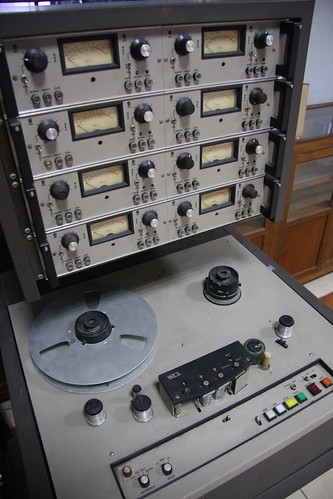
Seemingly innocuous, retro cool even, but certainly, utterly, even meaninglessly fetishistic... a little piece of Tamil movie history. If interested I could actually get you a list of songs recorded on this machine, from the engineers who did most of the recordings.
Labels: Film, Photos, Tech, Work
Sunday, November 25, 2007
Lost Purposes
Eliezer Yudkowsky's piece Lost Purposes is another one of those thought-provoking things that he regularly churns out at Overcoming Bias.
He writes:
"As you read this, some young man or woman is sitting at a desk in a university, earnestly studying material they have no intention of ever using, and no interest in knowing for its own sake. They want a high-paying job, and the high-paying job requires a piece of paper, and the piece of paper requires a previous master's degree, and the master's degree requires a bachelor's degree, and the university that grants the bachelor's degree requires you to take a class in 12th-century knitting patterns to graduate. So they diligently study, intending to forget it all the moment the final exam is administered, but still seriously working away, because they want that piece of paper."
He continues to explore the intricacies of what is well spelt out in the title of his blog-post.
Take for example the case for a film school in Chennai. Going by the quote above, one should think that it would not get into the rut of producing graduates with paper diplomas because the 'industry' values performance more than paper. In fact, one would safely assume that since the industry is quite comfortable with its apprentice system of education, a film school would actually have to produce performers in order to stay alive.
Of course this might be quite true for the government run film-schools which anyway do not depend on the patronage of the industry to exist. I do not have the numbers to back up a claim that formal education is of no effect in the mainstream industry. It appears that I have to go by 'perception'. But maybe the general absence of any reputable organised private training institutes (considering the scope, scale, and age of the Indian film industry) could point to the irrelevance of formal organised training as far as the film industry is concerned? So taking up 'perception', barring 'technicians' there is generally very little respect for aesthetes out of film school.
So here the general conclusion would be that the idea of lost purposes would not apply to a private film school. This sounds too good to be true (not that this doubt is any cause to deny its correctness).
We need to see at what point in the evolution of the film industry does a formal film-school become relevant, and even possible? This considering the fact that the industry itself has somehow found an optimum in non-formal education. (I seriously doubt the other assumption that the government film-schools were sufficient).
Many hail the 'corporatisation' of the the film-industry as the big thing that is going to take the industry by storm. This necessarily involves a restructuring of 'employment' within the industry. Here is where a paper diploma becomes useful for its paper. And correspondingly, this has seen a sudden surge in the number of private film-schools.
OK, before I come across as a Gandhian champion of subsistence filmmaking, where everybody somehow seemed to have learnt with a 'purpose', I have to start rethinking what employment really means in the film industry.
Am I to assume that somehow everybody found their 'purpose' before blind corporatisation turned them into mindless and purposeless proletariats? No. Am I also to assume, in extension that corporatisation is going to suck creativity and accountability out of the system by getting rid of the close-knit information structures that helped recruitment in the past? No. Why not? Well, probably because for one, I am not a Gandhian romantic.
Even in subsistence-filmmaking, a job was still a job. If you got paid better climbing a ladder and holding onto a light, than sawing planks of wood and painting them pink, you would try to train yourself to climb heights. The sole 'purpose' is to get employed and make money not some romantic ideal of 'I would make a better grip or carpenter'. Smith, rather than Ricardo. Now this idea would be harder to reconcile when talking about other technicians or artists. “Surely, one does not become a Cinematographer just because it paid better, you need to have it in you”. But is this really true? Yes, you need to have it in you, but if you 'had' it, and then if it paid peanuts?
So even in the subsistence industry, employment and wages follow the same basic rules, but one other thing happens. The idea of 'purpose' gets romanticised. In a glamour industry where signalling plays a huge part in remuneration and status, connections and level at entry play a very important role. Ability, or qualification and ironically, ambition and 'purpose' have very little say.
This is probably the reason why formal education was disregarded, not because it was 'purposeless' but because qualification meant squat. I have already made the case why formal education is not something that is contradictory to informal teaching, but merely the evolution of how people skilled themselves.
Now if ambition and ability had nothing to do with how things were, how does this new 'corporate' culture with its 'lost purposes' fare any better? For one, in its 'ruthless' ways, the corporate would minimise the costs of 'signalling'. There will be those without purpose (as they always were) but the ones who will be more successful are the ones who can still find their own goals and work towards them. Julian Simon comes to mind. The corporate film industry is not ideal, but even less ideal is the feudal subsistence film industry. At-least in the former case, individual human enterprise is unleashed, and maybe even contemplate 'purpose'.
Labels: Economics, Education, Links, Work
Monday, August 20, 2007
Where Tyler Cowen thinks I'm worth investing in
Now who would've thunk eh? I of all people to receive a merit-based gift from Tyler Cowen?
Well, I'm also quite happy that I can make a decent pitch. So now, I have one really compelling reason to find time to make a film.
I have not read Prof Cowen's new book yet, but just to see how incentives work, I've put up a flyer at work asking for short screenplays and promising the chosen writer money and full screenwriting credit. 1. I hardly get time to write my own stuff. 2. I have to get used to directing other people's writing. And 3. I teach people that more than one creative mind can actually enhance a film, and would like to see if I can come up with a first-hand example. Let me see if I can also come up with some mechanism to chose a decent crew as well.
So thank you Prof Cowen, and thanks Shruti for telling me to give it a shot.
Labels: Economics, Film, Other, Work
Friday, May 25, 2007
And because the grapes were sour
Two areas of film practice where I believe I have demonstrable and transmissible skills are in location sound recording and production management. And as sod would have it, these are precisely the disciplines where the industry I work in chooses to display maximum inertia.
Let us take Synch-sound recording for example. There have been a few attempts at it, and it is precisely these so-called attempts that the nay-sayers use to show how impossible it is to practice proper synch-sound recording here. Here is my take on this. Location sound recording is a craft that needs to be practised by trained professionals. OK, so we import a few recordists, WTF? But here is the deal: just like every other craft in the films, this too does not work in isolation.
Who does your so very crucial clapper: Some random errand-boy assistant director, and not the same person everytime. The clapper is a crucial technical task best left to a technician. I prefer a member of the camera team do it. They know the lens and the cameraman.
Announcements: They are too random and not very clear with directors preferring to blare over the PA than give calm direct instructions. And please be advised, you are not saving any film stock by compromising on the announcement/clap. You're merely protracting post-production.
Reports and continuity notes: What goes on the board and what goes on the sheets are very crucial when it comes to synchronising the rushes and naming sub-clips. A script supervisor is not some guy who you reserve to do the prompting.
The attitude: Fixing it in the dub is fallacious and is the path to ruin. Also, when you do a recce, remember not to shoot 1890 period pieces next to PH road. Also remember that sound is half your movie.
With a system like this, no sound recordist or boom operator can make magic. Then the unreachable grapes... oh they are sour!
Labels: Education, Film, Tech, Work
Tuesday, April 24, 2007
The standard excuse for boring essays on blogs—Going Mainstream
A Formal education in film
Education and training in the crafts required by the Tamil film industry have traditionally been informal. 'Informal' here does not mean some sort of flexible learning programme providing various choices to the student. It usually involves a young aspirant apprenticing under an established filmmaker. In such a system, film apprentices are expected to pick up technical, managerial, narrative and business skills from their mentors. More often than not, they also imbibe an aesthetic, social and political 'taste' from their 'gurus' as well.
Over time this mentor system has neatly evolved the efficiencies and standards of an effective proto-formal educational system. This is reflected in its ability to afford the 'student' the opportunity to build up a contacts-list and network within the industry—being a student of film (usually an assistant to a known filmmaker) is a terrific excuse to meet people (actors and producers). The mentor often provides the required references and appraisals to enable the apprentice to land that crucial 'break'. Just as educational institutions build up reputations over time, some filmmakers are also reputed to churn out quality filmmakers (while there have also been others who have not). 'Graduates' are provided with word-of-mouth qualification instead of certified sheets of paper.
The absence of decent centres of formal education in Tamil Nadu (for a while there has been one government-run film institute in Tharamani) and the relative success of such informal modes of education and training have reinforced our notions of what constitutes an education in the arts, crafts, sciences and businesses of filmmaking. But there are certain drawbacks to such a system that are slowly being recognised and addressed. For example, it would be fallacious to assume that all great filmmakers are great film mentors, or for that matter, the inverse about not very successful filmmakers as well. Since taking on apprentices is very closely linked to jobs at hand, jobs in the bag and filmmaking success, this is a crucial issue.
The ability to understand and teach filmmaking is completely different from an ability to make wonderful films. As always, there are bound to be exceptional cases, but just as is reflected in the very nature of the industry, a minuscule percentage of possibly huge success seems to be the only driving force behind a very large number of attempts and failures. While seemingly unviable, this is the truth behind the film industry as it has been until now—hardly a way to build careers, leave alone hopes and dreams.
Interestingly today, the industry is changing rapidly, both technically and as a trade. Audiences are also seeking wider choices with their changing lifestyles. The very hit-or-bust nature of the system that has hitherto propped its sustenance and evolution has itself hit an evolutionary steep-curve.
Reaction to change comes in a myriad of shapes. Some inside and outside the industry wrongly assume that formal education in film is an alien concept that has suddenly crept up on the Tamil film industry to shake it up and set new rules. But there are also those that agree that formalisation of film education is merely the process by which the industry itself deals with all the changes happening within and outside of it.
For one, informal education is not scalable, and second, there is only so much learning that a student can imbibe under a single mentor. Most importantly, a changing and growing industry needs trained specialists, and not the generalists a smaller scale might support. The changes in the technical, social, aesthetic, as well as the commercial and managerial aspects of filmmaking also require research, study and understanding that formal education can accomplish systematically. Informal education can only deal with such challenges with a series of potentially very expensive trials and errors.
We have produced some of our best filmmakers through the informal system, and it is a result of their education that things are being systematised and formalised today. For the evolution of film-education only mirrors the evolution of filmmaking itself. Tamil film has changed from being a romanticised small-scale cottage-craft involving huge risks (of course, this has not always been the case with early Tamil/South Indian cinema thriving under a robust studio system that later unravelled), to being a slightly better-organised industrial activity today. The industry eagerly seeks newer challenges and newer ways to define itself as a purveyor of entertainment while providing rewarding career options for aspiring film professionals in the arts, sciences, and business of film.
Informal education will continue to fill the gaps in expertise and genius that such a volatile industry thrives on, but for those seeking to build careers in the entertainment world, formal education is the better bet.
This thingy with various modifications (not by me) might grace a newspaper sometime soon. I also have to produce a Tamil translation by tomorrow!
Sunday, April 22, 2007
Could be purely anecdotal...
But, what I saw in Loyola earlier last week seemed quite revelatory. You see, things have moved on since when I studied there sometime last century. While my education was almost entirely subsidised by a UGC grant, there are a category of students today who pay fully for their courses. Loyola refers to them as the SS (self-supporting) stream.
Now since no respectable Indian educator would like to be seen to sell education, the government subsidised stream too continues to exists. I suppose Loyola has an interesting admission policy, but as an examiner, what I saw of the quality of the students was fairly appalling. As any old-boy is bound to bemoan, I lamented the shocking drop in standard in the more coveted regular stream—my successors.
Later I had a chance to meet the SS bunch. Now, these students are the ones who have paid for their seats, and as many teachers are bound to complain, are the ones who demand a degree simply because they have spent their money on it. The students of the 'subsidised class', on the other hand, are dutybound to gratefully accept their education. Also since they were choice candidates during admissions, the regular stream students are expected to perform well in their exams.
But guess who did better in my exams? I can only assume that those who paid for their education value it more than those who know they've got it cheap. Either that, or Loyola with its characteristic patronage dumps its rejects in the charity class.
Labels: Economics, Education, Work
Friday, March 30, 2007
To Protect the Child
When I was a kid, there were consolation prizes in school contests. Until we understood the appallingly patronising semantics, we saw it as the legitimate last rung in the hierarchy of awards. Then there were middle-school debates that were sanctimoniously labelled "academic" (euphemism for "rigged at the time of deciding the topic") lest our sensitive minds be exposed to acrimony and disagreement.
Not too many years ago, kids versions of television contest (mostly singing talent shows) never announced winners—every participant took home the same crummy gift-hamper.
Now apparently, this Super Singer Junior reality show on Vijay TV has pictures of kids being rejected (they have candy I suppose), also of kids behaving like little spoilt divas, and also of kids singing really well and winning.
Then I came across this (via). Now I may not entirely agree with a dogmatic view about "good competition", but I do see in my line of work that a system of incentives (and disincentives) really produces results, if the system is deemed to be even nominally "just" by its members.
Kids, I have seen, have a terrific sense of morality, fairness and "right".
Labels: Libertarianism, Links, Media, Politics, Work
Friday, March 16, 2007
Notional
A little education puts a lot of 'notions' into our heads. But pray tell me how can the screen accommodate anything other than pictures and sounds?
Monday, March 05, 2007
Can you define?
Just to revive an old discussion (for which I cannot be bothered to dig up permalinks from the archives), what do you think are the differences between:
1. what a screenwriter does, and what a director does?
2. what a director does, and what a producer does?
Not too many people in 'the industry' seem to know the answers, especially those who think they do. And while on the topic of wholesome ignoramuses, please stop calling production managers, production designers. That does not sound cool, that is merely being stupid!
Saturday, March 03, 2007
A desk-top I desperately need
Seen something similar twice before: one a video of some Canadian (I think) college guys demonstrating a lab project, second in Spielberg's Minority Report.
Now, Brian Lam at Gizmodo might be right when he points to "the inverse relationship of proper ergonomics and proper viewing distance on such a setup", but in my line of work, this sort of a thing would be a godsend. So much for geeky wowdroolmultitouchwanking.
I spent a good part of last week snipping, labelling, taping, ordering, re-labelling, matching, tagging, checking, and arranging strips of paper to schedule 11-member crews (from a list of 29 persons) to work over three weeks to make 20 short films. Sometimes all that jugglery and anal attention to detail can be pretty fulfilling, Zen even; but most of the time you really feel that your desk could do with some 'memory', that you don't have to take down every little permutation down to cross-reference or reconstruct later.

