

Archives
Blogs with feeds
Blogs without feeds

updated
Monday, April 07, 2008
Flickr Pro
I've finally decided to pay for something that's an online service. I've gone Pro on Flickr. Check out my pictures here. Having invested in a யானை of a camera, might as well get the அங்குசம்!
Oh! One of the advantages of working where I do is the facility to get pictures of things such as this. 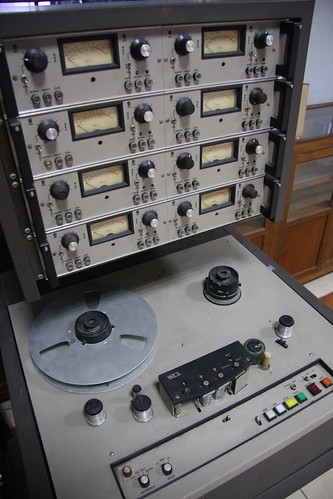
Seemingly innocuous, retro cool even, but certainly, utterly, even meaninglessly fetishistic... a little piece of Tamil movie history. If interested I could actually get you a list of songs recorded on this machine, from the engineers who did most of the recordings.
Labels: Film, Photos, Tech, Work


Tuesday, March 18, 2008
RIP Minghella
The one time I met 'Ant' was when I blagged my way into his masterclass at the Watershed at Brief Encounters 2005. He was scripting Breaking and Entering then. I greatly admire his work on The English Patient and Cold Mountain. Minghella was a close collaborator of my favourite movie geek Walter Murch.
The book I'm currently reading, Charles Koppelman's Behind the Seen is a fascinating look at how Murch worked on Cold Mountain, and provides lots of insights into Anthony Minghella's workings as well. Was also lining up a viewing of Breaking and Entering, DVD courtesy a dear cousin. I shall now read the rest of the book and watch the movie, with a little bit of regret.
Tuesday, February 05, 2008
Constructive Editing
David Bordwell writes this very enlightening piece about the history and the practice of constructive editing, and aptly titles it “What happens between shots happens between your ears”. Well worth a read.
Labels: Education, Film, Links
Monday, August 20, 2007
Where Tyler Cowen thinks I'm worth investing in
Now who would've thunk eh? I of all people to receive a merit-based gift from Tyler Cowen?
Well, I'm also quite happy that I can make a decent pitch. So now, I have one really compelling reason to find time to make a film.
I have not read Prof Cowen's new book yet, but just to see how incentives work, I've put up a flyer at work asking for short screenplays and promising the chosen writer money and full screenwriting credit. 1. I hardly get time to write my own stuff. 2. I have to get used to directing other people's writing. And 3. I teach people that more than one creative mind can actually enhance a film, and would like to see if I can come up with a first-hand example. Let me see if I can also come up with some mechanism to chose a decent crew as well.
So thank you Prof Cowen, and thanks Shruti for telling me to give it a shot.
Labels: Economics, Film, Other, Work
Tuesday, July 31, 2007
And now Antonioni
Just a day after Bergman, Antonioni has gone ahead and snuffed it! There's something that's killing 'em all off.
Monday, July 30, 2007
Bergman is dead
Having given us some very good films, he also inspired many comics. Here is a link to The Dove, among the best Bergman parodies.
Update: Here is the full film from Google video (via)
Friday, June 22, 2007
The Boss
It was ridiculousness and ridiculousity made flesh!
And when the film itself begs you to not take it seriously, you simply enjoy it.
I loved it!
Labels: Film
Sunday, June 03, 2007
Sivaji - The Boss
Almost everybody seems to think that Sivaji cannot fail. After all, there's Rajnikanth, Shankar, AR Rehman and lots of DI. But what if it does? Just trying to be contrarian, and for the superstitious among you, let me be damned.
If it were to succeed or fail, when would we know? Would we know at all? What is success? The film is expensive enough for box-office success to matter. And the fanboy crowd is large enough to take it through the initial few weeks without adverse word-of-mouth affecting it. In any case, I shall be watching this film closely. Should tell me a lot about how Tamil cinema economics works. And the things to watch out for are:
1. Do the projectionists/director/producers start making changes in the film, and if they do, when.
2. Are more prints going out of the labs? Or are some prints coming back in two weeks time?
3. At what point is it going to do the rounds of the second-rung NRI towns?
One thing is almost certain. It is impossible within the first two (or three) weeks to do any sane predictions on how the film will fare. I'm willing to start considering analyses that come after that.
What not to really worry about:
1. Random newspaper and magazine reviews.
2. Television spots and interviews with the likes of Antony.
3. Gossip about how much AVM sold such-and-such rights for.
4. Politicians like Ramdoss making some noise.
The thing that could potentially play spoilsport is the stupid price-ceiling the government introduced a while back. But I do have a lot of faith in our cinemas to circumvent that.
Friday, May 25, 2007
And because the grapes were sour
Two areas of film practice where I believe I have demonstrable and transmissible skills are in location sound recording and production management. And as sod would have it, these are precisely the disciplines where the industry I work in chooses to display maximum inertia.
Let us take Synch-sound recording for example. There have been a few attempts at it, and it is precisely these so-called attempts that the nay-sayers use to show how impossible it is to practice proper synch-sound recording here. Here is my take on this. Location sound recording is a craft that needs to be practised by trained professionals. OK, so we import a few recordists, WTF? But here is the deal: just like every other craft in the films, this too does not work in isolation.
Who does your so very crucial clapper: Some random errand-boy assistant director, and not the same person everytime. The clapper is a crucial technical task best left to a technician. I prefer a member of the camera team do it. They know the lens and the cameraman.
Announcements: They are too random and not very clear with directors preferring to blare over the PA than give calm direct instructions. And please be advised, you are not saving any film stock by compromising on the announcement/clap. You're merely protracting post-production.
Reports and continuity notes: What goes on the board and what goes on the sheets are very crucial when it comes to synchronising the rushes and naming sub-clips. A script supervisor is not some guy who you reserve to do the prompting.
The attitude: Fixing it in the dub is fallacious and is the path to ruin. Also, when you do a recce, remember not to shoot 1890 period pieces next to PH road. Also remember that sound is half your movie.
With a system like this, no sound recordist or boom operator can make magic. Then the unreachable grapes... oh they are sour!
Labels: Education, Film, Tech, Work
Sunday, May 06, 2007
How do you know when to take that cigarette break during a film you've never seen?
Paruthiveeran is quite a remarkable film. Ameer's command over his mise-en-scene is masterful and the film is best enjoyed in a packed hall.
The last time I met Ameer, he seemed quite piqued by the film certification/censorship system in India. I have little doubt that he would have had to fight his case hard with Paruthiveeran as well. Well, whatever we might have to say about the merits of the system, attending this screening has taught me a lot about the sheer worthlessness of film certification/pre-censorship in India.
This film with its recommended cuts and generous admissions has earned a U/A, the equivalent of a PG-13. Not that I entirely approve of a monolithic classification system but let's say I do so for arguments sake. This film should have got an A (15+) for general mature content, strong language, protracted graphic unarmed combat, violence with sharp objects, and a disturbing scene of rape. Since the film has outraged my morals, I can actually take the board to court for telling me that it is OK to take my family to this film.
But in reality, I do not think that any one person's system of rating actually works for everybody else. This means that I never really mind the Tamil movie audiences' penchant for bring little kids to watch people being killed. Now, if not me, somebody else might express moral outrage at such irresponsible parenting. Film pre-censorship wishes to do just that, and hopelessly fails. Not just because enforcement is lax, but because people (and parents) have already made informed choices and really don't bother about some silly piece of paper. So the next time you see a 6-yr-old sitting next to you enjoying that really raunchy item-number, it is quite possible that the parents are neither ignorant nor irresponsible, they might just be very liberal.
Let me digress a little. Arthur De Vany in his excellent book Hollywood Economics refers to a "turning point" during a film's run (he mentions 4 weeks after release) where the revenue curves for the hits and misses dramatically diverge. This might appear to be imitative herding, but De Vany explains that it is in fact a result of a word-of-mouth information sharing system among the (potential) audience members. Technically we all decide if a movie is a hit or not, but interestingly cannot predict how we're gonna decide.
It is easy for all us movie-goers to acknowledge the existence of word-of-mouth information, but it is remarkable to see how big a role it plays in a film's success or failure. Getting back to our film, Paruthiveeran is in its 11th week. We cannot empirically confirm the 4-week rule for Tamil cinema, but it is quite evident that the film is already a box-office success. The audience is pretty much already clued-in and know what to look forward to in the film.
Broad assumptions about media effects, and the influence of such a powerful medium as film on our poor audience, are significant bases for film pre-censorship in Indian law. To tell you the truth, Paruthiveeran is a disturbing film, it is a powerful film, it certainly is designed to elicit a loathing born out of frustration (all a la Straw Dogs), it also is meant to zap young men to spontaneously dance in the aisles during the folk song numbers.
A study of media effects should not merely stop at "does it or does it not". "What happens then" is where we should continue, and this is where ideas differ. I personally subscribe to the idea that "wilful suspension of disbelief" lasts until we walk out of the doors, or a minute and a half into the end credits, whichever happens first.
But what really matters is that even if people do get affected/influenced by films, they all do not react the same way, and more importantly, they use the same word-of-mouth information sharing system to temper/modify their reactions to the film. I do not know how many were repeat-audiences for this screening of Paruthiveeran, but about a 3rd of the hall emptied just before the beginning of the infamously disturbing rape scene. Yes, some people do not want to be disturbed by the film. But they make that informed decision and simply walk out at the exact right time.
It appears we are more knowledgeable and responsible than we would like to acknowledge we are. And the central board of film certification takes us for fools. Also, we really don't care what they think.
Labels: Economics, Film, Law, Libertarianism
Tuesday, April 24, 2007
The standard excuse for boring essays on blogs—Going Mainstream
A Formal education in film
Education and training in the crafts required by the Tamil film industry have traditionally been informal. 'Informal' here does not mean some sort of flexible learning programme providing various choices to the student. It usually involves a young aspirant apprenticing under an established filmmaker. In such a system, film apprentices are expected to pick up technical, managerial, narrative and business skills from their mentors. More often than not, they also imbibe an aesthetic, social and political 'taste' from their 'gurus' as well.
Over time this mentor system has neatly evolved the efficiencies and standards of an effective proto-formal educational system. This is reflected in its ability to afford the 'student' the opportunity to build up a contacts-list and network within the industry—being a student of film (usually an assistant to a known filmmaker) is a terrific excuse to meet people (actors and producers). The mentor often provides the required references and appraisals to enable the apprentice to land that crucial 'break'. Just as educational institutions build up reputations over time, some filmmakers are also reputed to churn out quality filmmakers (while there have also been others who have not). 'Graduates' are provided with word-of-mouth qualification instead of certified sheets of paper.
The absence of decent centres of formal education in Tamil Nadu (for a while there has been one government-run film institute in Tharamani) and the relative success of such informal modes of education and training have reinforced our notions of what constitutes an education in the arts, crafts, sciences and businesses of filmmaking. But there are certain drawbacks to such a system that are slowly being recognised and addressed. For example, it would be fallacious to assume that all great filmmakers are great film mentors, or for that matter, the inverse about not very successful filmmakers as well. Since taking on apprentices is very closely linked to jobs at hand, jobs in the bag and filmmaking success, this is a crucial issue.
The ability to understand and teach filmmaking is completely different from an ability to make wonderful films. As always, there are bound to be exceptional cases, but just as is reflected in the very nature of the industry, a minuscule percentage of possibly huge success seems to be the only driving force behind a very large number of attempts and failures. While seemingly unviable, this is the truth behind the film industry as it has been until now—hardly a way to build careers, leave alone hopes and dreams.
Interestingly today, the industry is changing rapidly, both technically and as a trade. Audiences are also seeking wider choices with their changing lifestyles. The very hit-or-bust nature of the system that has hitherto propped its sustenance and evolution has itself hit an evolutionary steep-curve.
Reaction to change comes in a myriad of shapes. Some inside and outside the industry wrongly assume that formal education in film is an alien concept that has suddenly crept up on the Tamil film industry to shake it up and set new rules. But there are also those that agree that formalisation of film education is merely the process by which the industry itself deals with all the changes happening within and outside of it.
For one, informal education is not scalable, and second, there is only so much learning that a student can imbibe under a single mentor. Most importantly, a changing and growing industry needs trained specialists, and not the generalists a smaller scale might support. The changes in the technical, social, aesthetic, as well as the commercial and managerial aspects of filmmaking also require research, study and understanding that formal education can accomplish systematically. Informal education can only deal with such challenges with a series of potentially very expensive trials and errors.
We have produced some of our best filmmakers through the informal system, and it is a result of their education that things are being systematised and formalised today. For the evolution of film-education only mirrors the evolution of filmmaking itself. Tamil film has changed from being a romanticised small-scale cottage-craft involving huge risks (of course, this has not always been the case with early Tamil/South Indian cinema thriving under a robust studio system that later unravelled), to being a slightly better-organised industrial activity today. The industry eagerly seeks newer challenges and newer ways to define itself as a purveyor of entertainment while providing rewarding career options for aspiring film professionals in the arts, sciences, and business of film.
Informal education will continue to fill the gaps in expertise and genius that such a volatile industry thrives on, but for those seeking to build careers in the entertainment world, formal education is the better bet.
This thingy with various modifications (not by me) might grace a newspaper sometime soon. I also have to produce a Tamil translation by tomorrow!
Friday, March 16, 2007
Notional
A little education puts a lot of 'notions' into our heads. But pray tell me how can the screen accommodate anything other than pictures and sounds?
Monday, March 05, 2007
Can you define?
Just to revive an old discussion (for which I cannot be bothered to dig up permalinks from the archives), what do you think are the differences between:
1. what a screenwriter does, and what a director does?
2. what a director does, and what a producer does?
Not too many people in 'the industry' seem to know the answers, especially those who think they do. And while on the topic of wholesome ignoramuses, please stop calling production managers, production designers. That does not sound cool, that is merely being stupid!
Tuesday, February 20, 2007
The Masculine Fixation of the Heroic Villain—A Critical Review of Mani Ratnam's Greceo-Capitalistic, Anti-feministic Discourse, "Guru"
I have many problems with Mani Ratnam's Guru. The least of its follies is that it is patently capitalistic, but its bigger message is what is hidden in its quasi-ontological implications. While on the topic of the general Greco-Capitalist mindset that pervades Indian mainstream thinking, the moral bankruptcy of Mani Ratnam in indicating that making profits is good, has made it very clear why he is in this business.
Coming from a country in which filmmakers like David Dhavan and Yash Chopra have spurned profits to veritably devote their lives to make meaningful cinema, Mani Ratnam shames their glorious names by proving that his aim includes making money, and in not letting cinema do its natural duty of enlightening and educating the masses. The poverty of the masters has been dealt a fiery blow with this film.
Getting to the more sinister aspects of Guru, we find that in his purveyance of capitalistic entertainment, Mani Ratnam's undercurrent gender stereotyping is only too obvious. Why is the protagonist male? Why cannot a woman or a gender minority have been named Gurukanth? In his denail of the non-male, Gurukanth can only naturally be male. And therefore an anti-feminine capitalist.
The Dutch-German feminist scholar Marta Nettrich-Kahn, in her seminal essay A Falsification of Progesterone (Fem-Sci, Vol 23, Issue 5, 1967) studies the phenomenon of maleness as that of being essentially non-female. Her essay also states that the fundamental male-female dialectic also produces a synthesis of the third androgyn, that evolves to encompass a phenomenology of rhetorical passivity. That is why, Nettrich-Kahn feels, the portrayal of the male in popular discourse often always entails the suppression of the female epistemen, while consciously isolating the non-congruation of the fifth transformation.
Mani Ratnam's Guru is a classic example of what Nettrich-Kahn goes on to describe as the profiteering phallic bourgeoisie. Almost all collectivist (female) syllogism are violently replaced by a domineering individualistic (male) gaze. The scene in which Gurukanth's wife is shown crying is a classic example of this. The train represents the phallus, and her journey on it represents her submission to the wills of the male guardian, who's discourse this entire film is based upon.
This capitalistic masculinity of the film also creates no space for the discussion of non-heterosexual phenomenology. The suppression of the female, and the left, and the south, is also extended to the suppression of the queer. By showing Gurukanth as being heterosexual, Ratnam also denies space for homosexual plasticism. In the initial scenes, an implication of a queer reading, scares Mani Ratnam into conventional right-wing narration, thereby proving his anti-gay tendencies.
The French enlightenment thinker Rene Chayreque defined the world of pictorial discourse as being of two types: The ones that move in the realm of the oppressed, and the others that move in the realm of the capitalist. The Chayreque Dialogue as it is more popularly known, defines the very foundations of motion picture in India. The capitalistic heterosexual masculinity of the total in its quest for shareholder maximisation, denies the emasculation of the female and the queer oppressed.
Noted Malayali film critic Kollam Kondozhi Kunnath in his description of TV Chandran's recent film Aadum Koothu, introduces the concept of the Madrasi Chickku in describing female actresses. The Madrasi Chickku is defined by over pigmentation and a general disfigurement of the countenance. Mani Ratnam's company is called Madras Talkies; therefore his depiction of the female conforms to these identified distortions. Further proving that Ratnam's decision to name his company so, is a deliberate attempt to bias his film output against the female. The film is also dangerously casteist in its refusal to showcase any non-brahmin characters. But that is to be expected of all of Ratnam's post Roja material, and therefore will not be dealt with in detail here.
If at-all there is one thing Guru is to be praised for, it is in its rightful portrayal of the character of Mallika Sherawat. The Turkish belly-dancer, is the only character that really stands up to the bourgeois trickery of the gambling male. But naturally, having introduced such a character, Ratnam, very quickly moves the action to India, as the Turkic revolutionary is too threatening to the fundamental morphology of the film, that deals with a status-quoist, middle-class, heterosexual urbanism.
Another place where Guru fails miserably is in its refusal to discuss, or even acknowledge the dangers of global warming. Since the recent UN report "unequivocally" recognises human causes for rise in sea levels, the film, which involves human characters and is set in Bombay, a coastal city, is only cynically cruel in its conscious avoidance of its moral obligation. Ratnam, is therefore naturally, a global-warming denier. Gramsci called the globe, The Mother, paving way for Gorky's book by the same name. Ratnam's refusal to deal with issues involving The Mother, is truly consistent with his depiction of the Madrasi Chiccku.
Overall, the film fails with its critically perverse notions of entertainment at the cost of moral purity. It is certain that the screening of this film would enrage anyone with a conscience. The Andolestic monastic Krishacharya was prophetic when he said that (the) right is always the wrong. Guru being rightwing Greco-Capitalistic, Anti-Female, Anti-Queer, Anti-Dalit, Anti Global-Warming and heartless, is certainly and emphatically "wrong"!
- Dr. (Mrs.) Valentina Dimitrieva Pandey
MA (lit.) MPhil (illit.) PhD(corres.) M.A.S. University, Darjeeling
(The writer is the Randal Zakuroff Chair of Gender Studies at the Department of Social Sciences, at the University of St Petersberg, Russia. She lives with her husband Acharya Somuchidononanda Pandey, and twenty two children in the Malyeshi suburb of St.Petersberg. She can be contacted at acsomuchval@pandey.ru)
Sunday, January 14, 2007
Now the home-video boom starts in Chennai
I mean the official version of the home-video boom. Currently, a very large part of the home video market, at-least in TN is hogged by the Thiruttu VCD 'pirates'. And I tell you, no matter how much I am supposed to hate them (for I am part of the industry that is purported to 'suffer' because of them), I can only blame the industry for not being shrewd enough to not cash in on consumer needs. A need that the bootleggers filled really well.
Maybe the industry is still nostalgic about theatrical, box-office collections (or of-late, satellite rights), or idiotic enough to not realise that the market is big enough to go low-price.
The word 'pirates' itself is fairly romantic and inaccurate. Their operations are in-fact as properly streamlined, and as tuned to demand-and-supply economics as any other industry. (They even have a long-tail—Bergman is very popular you see!). They have a very good distribution system, including young men selling DVD's in railway compartments along with peanuts and plantains.
The only problem is that they are doing something technically illegal, and therefore are subject to extortion from the anti-piracy squads. This cost, the pirates pass on to the consumer; but since the scale of operations is so huge, they can still beat the horribly expensive prices quoted by the 'official' vendors.
Now, the pirates obviously save on 'rights costs', but incur the comparable 'maamool' instead. So, if only somebody could make the 'official' duplication and distribution cheap.
Moser Baer proposes to do just that (warning! PDF link). And the prices they quote seem to be in line with my assumption about the 'rights costs'.
This is the way to beat piracy. Not by creating stupid regulations that line the pockets of inspectors. Bootleggers show up where consumers feel official vendors overprice; and piracy does not go away while they can bribe the inspectors, and yet give the consumer a good-deal. The money only comes back into the industry when piracy inspectors fund films.

